Saturday, February 27, 2016

Puerto Varas (February 19th)

Friday, February 19th 2016

We opened the door of our tent to find a rooster no more than two feet away and crowing repeatedly! Luckily we were already awake trying to get a head start on breakfast. We figured it would be really busy since there were so many tents and all of the beds in the house were full. Breakfast is set up at a table in the kitchen and only has room for about 8 people. We were surprised to find that no one else was eating when we got inside! We each ate 4 of the typical Chilean bread rolls with honey and cherry jam (this time free of rocks!) that we have come to love so much! 

We let our tent dry out from dew while we had breakfast. After we were all packed up, we walked back down the hill to the bus station to catch one of the frequent buses to Puerto Varas. Puerto Varas is the most touristy town in the region and is along the way to our next destination, the Cochamo Valley. It is much more scenic than Puerto Montt with its location on the shore of Lago Llanquihue (Yan-Key-Way) with views of two volcanoes.

We accidentally stayed on the bus too long, because we kept expecting it to pull off on the same street that buses going to Puerto Montt pick up on, but it never did. We ended up getting off a few kilometers down the shore of the lake and had to walk back. It was a lovely walk though. Once we arrived back into town we began looking for a hostel. We had difficulty finding the first place since it was off the edge of the map in our Lonely Planet book. It ended up being full, and so was the next place we tried. We were getting tired and frustrated, but luckily found a nice blackberry bush where we stopped and took refreshment. After about an hour of walking around, we found a hostel that had space for us to camp in the backyard. The hostel is called Compass Del Sur and is a big old wooden house located on a hill above town. 

While we were getting situated we got to talking to an American girl that was in the kitchen cooking when we arrived. Her name is Nancy Rose, and she is on a one year trip in South America, all expenses piad by fellowship money that she was granted after graduating from Harvard! She told us about some food trucks down by the lake and we gleefully went on our way to inspect. It was about time we had a good meal! We were in heaven and overwhelmed with the options! We ended up sharing a veggie burrito from a Mexican food truck and a veggie burger and vegan blueberry banana ice cream from a vegan health food truck! We also had two pieces of different styles of kuchen (German style cake). There were probably 15 food trucks in total, and we decided we had better come back for dinner!

We spent the afternoon in the hostel talking more with Nancy Rose, and another guy who joined us where we were seated outside, Johnnie Mac. He was an older guy from Boston, who was a musician and a carpenter. He´d just finished a 6 week job at a Chilean summer camp for rich kids. It was impossible to have a normal conversation with him, or to even get a word in, he completely monopolized the conversation. (He has a website, you can look him up if you want to!) He was interesting and played some songs for us, and was definitely a talented musician, but after awhile it being all about him got annoying. After several hours we managed to escape with Nancy Rose to return to the food trucks, where we enjoyed french fries and falafel burgers.

We felt as if we had wasted the day talking to Johnnie Mac, as we had not been able to focus our attention on making further travel plans. With the abundance of wonderful foods available in town, the urge to be Señor Turista for one more day was strong, but we decided that we would move on to Cochamo the next day, since it looked like a good weather window was opening up for us. We made a rough plan before bed with the help of a map of Cochamo that Nancy Rose gave us. (She had already went.) Cochamo is considered the Yosemite of Chile with numerous granite domes and abundant rock climbing. We are excited to get back out on the trail! Our plan is to through hike into Argentina, coming out near the town of Bariloche.


Tents crammed in the back yard at Casa Perla

A map of the area around Puerto Montt and Puerto Varas. It also shows the Cochamo area and the route into Argentina that will take 5 to 6 days.

We are back in the land of hydrangeas. This was a very pretty colored one!

Puerto Varas

Blackberry refreshment

Lots of nice flowers all around town.

Lago Llanquihue with views of Osorno and Calbuco Volcanoes.

Maqui Bliss Burger from the Bless Yuz food truck. In Chilean Spanish Yuz is pronounced like juice is in English, so the name is a play on words, as they make lots of fresh juices.


More nice flowers and an assortment of just a few of the many food trucks.

Blueberry kuchen.

Nice map of the area that details a route we may take when we return to Chile.

Another nice poster on the wall at our hostel, shows all of the lakes and volcanoes in the area, starting with Pucon in the North/left side of the photo.

Chaitén and Parque Pumalin (02/16-02/18)

Tuesday, February 16th 2016

Thankfully our 12 hour bus ride was only 10 hours, because it was pretty awful! Our guidebook said it could be anywhere from 9 to 11 hours, but we mentally prepared for 12, since the buses seem to always take longer than they are supposed to. We were in a 31 seat mini bus, filled entirely with backpackers. Every seat was filled, with a couple people sitting on the floor by the door. We were up on a platform in the back row which was 5 seats across. Because we were up slightly higher than the rest of the bus when the seats in front of us were reclined they were in our laps, and they were reclined most of the way. Not all of the backpacks fit in the luggage compartment, so there were something like 10 of them creating a mountain down the aisle between the front and back of the bus. There was no bathroom on board. We were allowed out twice to pee for no more than 10 minutes each time, and we had to climb down the aisle on the arm rests to get out. The driver took additional smoke breaks for himself, but left the passengers locked inside. The only windows were small horizontal vents located at the top of just a few of the windows. We luckily had control of one of the windows, because we were the only ones to keep it open. It rained the whole way, so it was incredibly humid inside. I rode with my credit card in my hand so that I could keep our window clear. Everyone one else left their window foggy, so we couldn't see out much. There seemed to be a problem with the air conditioning, because it only came on when we were stopped. The first few hours were on paved road, but the rest was horrible rutted and potholed dirt road. We probably traveled at under 25 MPH for much of the way. The highlight of the ride was definitely our veggie sandwiches!

The outside scenery was lush green rainforest vegetation, raging rivers and waterfalls and foggy misty mountains. We drove through many miles of Parque Nacional Quelat, and park we had wanted to visit, but logistically it was too difficult without a car. We could have gotten off the bus there, but getting a ride away from there is the problem. All of the passing buses are always full and we would have had a million hitchhikers to compete with, and in the pouring rain, so we are glad we did not try to go there. 

We arrived to Chaitén around 6 PM to more pouring rain. Our backpacks had been the last two to fit into the luggage compartment, but since we were at the back of the bus, they were throw out into puddles while they took all of the rest of the backpacks out and we waited to get off. We had to walk around in the rain to 6 different hotels/guesthouses before finally finding space in the house of some old lady who had a tiny LCD sign in her window that read "hospedaje" or lodging. It turned out to be a really nice room and house with a warm wood stove going for us to dry our stuff out around. The lady made us fresh sopaipillas and we talked with another couple that was there. Ignacio and his girlfriend Maria Paz. He had spent a year in New Zealand boxing kiwis and could speak English quite well. He was quite young, just 21, but had many funny yet unfortunate stories of his travels and bad things that have happened to him, like being bit by a brown recluse spider, being stung by a poisonous starfish in Samoa and getting dengue fever in Ecuador! They were from Santiago and he invited us to come stay with him for free when we make it back to Santiago. They also rode the bus from Coyhaique today, but with a different company. Their bus left at 6 AM and ours left at 8, but we arrived about the same time, so I guess we are lucky in that respect! (Their bus made longer and more frequent stops.)

Today was easily the worst day of our trip so far, but thankfully it ended on a happy note.

(Very pleasantly surprised by the very nice room and quilts in the random house in which we stayed.)

Wednesday, February 17th 2016

Chaitén sits in view of 3 volcanos, Corcovado, with its perfect cone shape, Minchinmahuida, which looks nothing like a volcano and is covered in snow and ice, and Chaitén volcano, which also scarcely resembles a volcano. In fact residents didn't even consider Chaitén a volcano until in erupted in 2008! The whole town was evacuated. It was buried by ash and then flooded due to a natural dam forming in the nearby river. It was years before the people were allowed back, the town just sat deserted. It is still recovering and people continue to repopulate the area. During this time Pumalin Park was also closed, and did not reopen until 2011. They have since constructed a new trail leading to the top of the new crater on top of the volcano. 

Our goal for our visit to Chaitén was to visit Parque Pumalin. This is another private park started by Doug Tompkins. I believe he bought the land in 1990, so it has been around much longer than Valle Chacabuco, and as a result has had many more years to be worked on. There are many trails and campgrounds, some lodging, a restaurant and a visitor center. Unfortunately none of it is accessible without a car. Chaitén is located on a small coastal strip of land between the Northern and Southern park sectors. The main road though the park in the Carratera Austral and is currently a very rutted dirt road, as it's been raining for days. Not much traffic comes through here, only at times where people are either coming from or going to the ferry crossing that is 55 km up the road. This makes it difficult to hitchhike, in addition to the fact that there are a million other hooligans to compete with. There is sadly no organized public transportation. 

Luckily today we woke up to clear skies! We decided to take a tour that would give us an overview of the park and allows us to hike a few of the trails. We chose a company called Natour which operates out of their food truck. I found out about this company after reading through a bunch of reviews on trip advisor. They allow only a maximum of 3 people on their tours because they have only a tiny 4 seater car in which to do the tours. We were a little disappointed when we showed up and learned that Tommy, the owner, would not be the one to give the tour, but that Tim a young German kid who happened to be volunteering there would be taking us. It ended up being a great day though! Tim is only 19, but he was very fun and interesting to talk to. He's spending a year in South American that he started in October volunteering for about a month in Parque Pumalin. He's since been all the way South and back up to Chaitén, where he's been volunteering at Tommy's tour agency for the last 3 weeks. He drove like a madman over the potholes like he was in a rental car and didn't care if he damaged it, but we had a good time on the hikes. We went to a look out where we got a view of Corcovado volcano, another view point for Chaitén volcano, a short loop through an alerce forest, a trail along a rushing river to numerous waterfalls and to a black sand beach where we saw Chilean Dolphins. Alerce trees are similar to sequoia or redwood tree. They don't grow quite as tall, as they are very slow growing, just 1 mm of growth each year, but they can live to be 3-4,000 years old! We saw many big old ancient trees! Few of these magnificent trees survived because the wood is waterproof and very durable, and as a result were made into shingles for houses. The bark has a sponge like quality to it, and expands when wet, so many of the trees were stripped of their bark. The bark was used as a natural caulking material in boat building.

We were out from 10 til just after 4. We had a short break that we used to cook some pasta on our camp stoves in the hotel room. We moved hotels today because it seemed our previous place was already reserved for the night. We are now staying in a hotel called Don Carlos. 

After our cheap dinner went back out and had a kayaking tour for a few hours around sunset time with views of sealions playing in the water and occasionally jumping out around our kayaks. We got to see the lovely sunset from our boats as well. 

(A look at one of the streets in Chaitén with Volcán Corcovado in the background.)

(Some of the destruction cause by the volcano eruption. The volcano is the gray looking mountain in the middle of the photo, certainly doesn't look like much!)
(Very lush vegetation, we are standing under a huge nalca leaf. These are related to rhubarb. The stems are used in a similar way to rhubarb to make jams.)
(A nice big alerce tree.)
(Jeff and Tim walking on a part of the trail that is over top of a fallen alerce tree.)
(This is the base of a really big alerce tree at the end of the alerce trail. According to Tim, the big mass is exposed roots from a time when the ground level was much higher.)

(This tree was maybe 10 feet across.)


(Lots of slippery stairs to climb up and down on the waterfalls trail.)


(Santa Barbara Beach. According to Tim it's rated one of the most scenic in Chile by Natinal Geographic.)
(Volcán Corcovado.)
(The Natour food truck. They had really good German crumb cake. Down here it's called Kuchen.)
(Another view of the town.)
(Sealions in the water during our kayak trip.)


Thursday, February 18th 2016

Last night we made no plans, deciding we would wait and see how the weather was. We awoke to soggy, misty mountains and rain. 

We went downstairs for our free hotel breakfast, and found it was again the standard round bread rolls with jam, butter and cheese slices plus instant coffee and tea. Because it was a fancier hotel, bread was brought out to the table for people individually as they sat down. We normally eat 3 or 4 each, but were allotted just 2. We sat for awhile and watched the other diners come and go and marveled at how they are barely ate anything. Some of them would cut a roll into quarters and eat only 1/4! I don't know if a single one of them out of 20 or so ate a whole roll. We are baffled and don't understand what and when Chileans eat! It seems that to most of them the instant coffee was their only interest.

After breakfast we went around town to explore our escape options. We had three options: take a 9 hour ferry north to Puerto Montt, take a 6 hour ferry across the bay to the island of Chiloé (then work our way north by bus and ferry over the next few days), or take a 10 hour bus and ferry combination to Puerto Montt. We had wanted to stay another few days and explore more of Parque Pumalin, especially the trail to the top of Chaitén's crater, but we don't want to sit around in a hotel all day waiting for the rain to pass.

Each ferry only goes 3 days a week, but today happened to be a day in which a ferry goes to both Chiloé and Puerto Montt, however, they were both sold out until Tuesday, 5 days away. So we went to the bus ticket office, the option we liked the least, and found out they were also sold out until Tuesday. We didn't want to be stuck for 5 days, so we considered hitchhiking, but there isn't much traffic through here and standing in the rain for hours waiting for some one to pick us up didn't sound too appealing. We learned that we could come back to the bus station and try to get on as standees, so we figured this was our best option. 

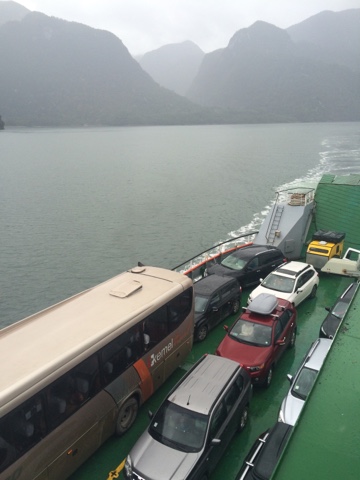
We went back to our hotel to pack up and headed back to the bus station. We were discouraged to find many others also waiting to try to get on the bus standing. It all worked out though and we made it on the bus. They packed in everyone that had been waiting, and it didn't appear there was any spare room in the aisle. We managed to somehow get a seat at the front of the bus. Everyone with a ticket was supposed to have a seat, but no one ever came to claim the seat. I sat on Jeff's lap for awhile, but eventually moved to the floor between his feet, which with the help of our foam z seats, was actually quite comfortable. We rode over bumpy dirt road for 1 1/2 hours to the first ferry. The ride on the ferry was half and hour. We reached a point of land, the narrow part of a peninsula, which we crossed by bus in about 15 minutes, then came to the next ferry. We lost track of time on that ferry, it was something like 4 hours. The weather remained foggy and drizzly and everyone was crammed into the indoor passenger lounge. We were on long enough for them to play a movie, a horrible violent Nicolas Cage movie called Joe. There was a small cafeteria on board where we were able to buy cookies, donuts and empanadas. After the ferry ride Jeff and I both got seats on the bus, since more passengers got off in Hornopirén, the town where the ferry ride ended. From there is was 3 more hours to Puerto Montt with one more short, 30 minute, ferry ride across the Estero de Reloncaví just south of Puerto Montt. We got into Puerto Montt around 8 and immediately found a Sopaipilla lady. We each ate two and called it a good dinner! 
From the terminal we walked a ways along the Costanera enjoying the warm sunny weather. It sure felt good to be back in a more temperate climate with more amenities and be done with the Carratera Austral and its bumpy roads and long bus rides! We decided to go back to Casa Perla, the guesthouse we had stayed in before. We figured the house would be all full, but she allows camping in her yard. We were able to squeeze our tent in between two other on an unfortunate slope, but we were happy enough to just be done for the day. It was another long annoying day of bus travel, but it was way better than it could have been, there were still at least 10 people still standing when we arrived to town!

(Map at the ferry office showing the different ferry routes, across to Chiloé island and up to Puerto Montt.)


(A map that makes the bus and ferry ride route make more sense.)
(We got to sit right behind the driver with a great view out the whole way. I wish my bus had a glass compartment in which I could isolate myself!)
(View up Estero de Reloncaví, Chile's northernmost fjord. We will be doing a hike up that way in the Cochamó Valley.)

Sunday, February 14, 2016

Chile Chico and Coyhaique (02/12-02/16)

Friday, February 12th 2016

The main goal for our day in town was getting our hiking uniforms washed. We accomplished this by taking our bag of dirty clothes to a local house that was recommended to us by the tourist office. We kept trying and failing to get the wifi at our campground to work so that we could come up with a new plan of action. We also walked up to a viewpoint above town, went grocery shopping and attempted to make ourselves a lunch in the midst of the food desert. The produce section in the grocery store had soft old apples, a few beat up tomatoes, onions, garlic and potatoes. Since we couldn't cook anything without access to a kitchen, our options were very limited. We came up with a lunch of French fries from the butcher counter in the store, boxed beans and vegetables and bread with jam. The day we get out of the food desert will be a grand day! It's kind of depressing to know that right across the border, 9km away is Los Antiguos, the Argentinean Capital of Cherries, the place where the cherries we ate in El Chaltén came from. We thought there would be lots of produce here, but sadly their is none!

Our next destination is Reserva Nacional Cerro Castillo, where we want to do another 4-5 day through hike. It is supposed to rival El Chaltén and Torres Del Paine in scenic beauty. Its main attraction are the jagged mountains, the most spectacular of which is Cerro Castillo, Spanish for Castle Peak. It indeed does somewhat resemble a medieval castle.

We tried to gather information on how to get there and execute the trek, in what order, etc. This was a difficult task without Internet access and also without a forest service office to provide information. In spite of this, we learned that to get to there from Chile Chico, you must take a ferry across the big lake, Lago General Carrera and from there it's another 40 km north by bus over the road. However, we also learned it's only 80 km (48 miles) from the north side of the lake to the next big town, Coyhaique (koi-eye-kay). Since it's paved road on the other side, it wouldn't be a long drive. After many hours deliberating we decided on going to Coyhaique. After a day or two in Coyaique we can travel back south to the park. 

We came to this decision for a number of reasons. There is no information in Chile Chico regarding the park, the local forest service office only provides information on Jeinimeni. We don't have a current trail map, just one printed in our trekking book almost 10 years ago, and we heard from the guys hitchhiking with us in Jeinimeni that some new trails have been added and that the start may have changed. We could have gone to the small town at the base of the reserve, Villa Castillo, but the bus from the Puerto Ibañéz on the north end of the lake doesn't go directly past there, as the lake is down a spur road and not on the main highway (Carrtera Austral) that Villa Castillo is located on. We would have been dropped off at the junction and would've had to walk 5+ miles south on the Carratera Austral (highway) or hitchhike, then hitchhike back north the next day to get to the start of the hike. The cost of the bus ride from the other side of the lake directly to Coyaique or to the junction with the Villa Castillo road are the same, no discount for getting off early. However, the bus ride only costs $7, so we figured we could go to Coyhaique, get park information from the local forest service office, find a hostel to store extra baggage in and not hike with it again, and also find me a pair of sunglasses, because I seem to have lost mine! We think I left them in the shelter at the campground the last day in Jeinimeni.

This is all information that continued to develop throughout the day, it wasn't until we got on the ferry at 5:30 PM that we really knew we would go all the way to Coyhaique. As a result we went grocery shopping in Chile Chico and bought all the necessary food for our camping trip, and we probably could have gotten it for cheaper and had a better selection in Coyhaique, which is a much bigger city with 60,000 residents, vs 3,000 and is also the capital of the region. Oh well.

The ride on the ferry was windy and rough, looking out at the swells, you would have thought you were in the open ocean and that's exactly how the motion of the boat felt. This is the lake that cost Doug Tomkins his life when he fell in after unexpected winds tipped his malfunctioning kayak. Now we understand why, it gets crazy when the wind picks up. 

The ferry took about 2 hours and from there we immediately boarded a bus to Coyhaique. The drive was very scenic, following along side Reserva Nacional Cerro Castillo and through a mountain pass for quite some time. We got to see many of the rocky peaks and glaciers. It has made us excited for the upcoming trek.

We arrived after 10 to Coyhaique with no accommodations reserved. We walked a few blocks to Patagonia Hostel, a German run place, and the only true hostel that we knew of. They had only 1 dorm bed left and when we asked if we could share it, they decided that Jeff could take the dorm bed and I could share a room with the reception girl. Apparently many people showed up looking for space, as multiple buses had left the ferry port at the same time. We feel very lucky, as we are quite tired! Tomorrow we will have our own room.

<Chile Chico and Lago General Carrera from the viewpoint.>


<This is what there is to eat in the food desert!>
<Rough water on General Carrera Lake during our ferry ride.>

Saturday, February 13th 2016

We were treated to homemade whole grain bread and homemade lower in sugar jams for breakfast at our hostel this morning. Most of the jams sold in the stores here have more sugar than fruit! We didn't accomplish much today, it was really cold, cloudy, drizzly and windy out. After breakfast we spent a couple of hours wandering around in the two very large nearby grocery stores and marveled at all of the food. They have a full selection of produce and just about anything else we could want. Unfortunately our hostel doesn't have a kitchen for guest use, so we can only dream of all of the things we could be cooking and eating. We ended up buying a box of cereal and a carton of peach flavored soy milk and we each had two giant bowls of cereal with bananas for lunch. Cereal is not a very popular food here. I think it's seen more as an extravagant health food, and we don't often find soy milk, so it was a nice treat.

The Internet in our hostel is not working, which has made it hard for us to make plans. This town has free wifi in the central plaza, so we went there to check the weather and found that it's going to be bad for awhile. I guess the typical Patagonia weather has finally caught up to us and our lucky streak with no rain has come to an end! Some girls showed up to our hostel this afternoon, having just come from Cerro Castillo. They had intended to do part of the trek we want to do, but said the weather was terrible (cold, windy, rainy) and they had to turn back. So we have decided not to go there after all. We are now deliberating about what to do next.

We went in a few stores looking for sunglasses for me, but they were either all radical sunglasses from the future or prohibitively expensive designer brands. 

For dinner we went out to eat at Mamma Gaucha, a restaurant and brewing company. It's the sort of hipstery place that uses local seasonal ingredients. Nothing on the menu was vegan, but we managed to convince them to make us a pizza and a salad with whatever the chef could come up with. They seemed resistant at first and probably thought we were crazy, but we ended up with a very nice meal. We also had a beer each, Jeff was excited that they had IPA, because that's not something we had yet to encounter down here.

<Never thought I'd be so excited to see iceberg lettuce!>
<These are the Triton cookies we have become slightly addicted to. They make big stores look full here by putting a million of the same thing on the shelves.>
<Refrigerated parfaits. If you look at the ones on the top, they are almost entirely dulce de leche/caramel!>
<A nice street side row of big butted mannequins.>
<Bread is such a staple food that every store sells individual rolls by weight. There are many different kinds to choose from. Many US grocery stores have similar offerings, but definitely not on this scale!>
<Our cache of poisonous food that I want nothing to do with now that we aren't camping! Better food can be had in towns.>
<A huge vegan salad with lots of nice green lettuce, mushrooms, cherry tomatoes, olives and artichoke hearts.>
<A fine veggie pizza at Mamma Gaucha with mushroom, onion, bell pepper and artichoke hearts.>
<The very inaccurate description of our hostel from the Get South free guide booklet.>
<Our private dorm room.>

Sunday, February 14th 2016

For the first time this trip we have been affected by being in a town on Sunday. Most everything in town is closed today. We did manage to get some bus tickets though. We will take a 12 hour ride North to Chaitén, where we will visit Parque Pumalin, the Tompkin's other park project. Buses only go twice a week to Chaitén, and the next one isn't until Tuesday, so we are stuck for now.

We decided to move hostels, because the one we were in, although nice (Patagonia Hostel), is expensive and we want a kitchen. We found out about another option, looking in a free guide book called Get South that was sitting amongst the reading material at the first hostel. I think the guide book is made by some agency that wants to promote tourism. 

We are now at Cinchao Hostel, just down the street from the first hostel and we now have a kitchen and it's less than half the price of the other place. This new hostel however is quite strange. There are 5 other beds in the room and none of them are occupied and the whole place just seems to be in a state of neglect, like the owners stopped caring about it weeks ago and the cleaning seems also to have stopped. There's trash and forgotten items all over the place and we haven't been given sheets and we can't tell whose really in charge here. There are two other dorm rooms, one of which seems to have quite a few Chileans in it. We are glad to have our own room, and don't really care that this is sort of a crappy dirty place, since we are able to cook. 

We went grocery shopping again and this time we were able to do more than just admire the produce! We actually got to buy some! For lunch I made us abundant plates of boiled potatoes with black beans, cucumber slices, diced tomato and avocado. And for dinner we had vegetable and bean soup, with the first broccoli we have had on this trip! We were able to get a whole head of broccoli at the store for only $1!

We also found a pair of left behind sunglasses, so now we no longer have to shop for a new pair and that is nice, since neither of us like shopping. We especially don't like shopping when it feels like you're in a maze wandering the city streets, going in one tiny store after another looking at the dismal selections. The central plaza here is in the shape of a pentagon and the rest of the town is built out around it, which makes it a little confusing to get around. Everywhere else we've been the streets are generally always a perfect grid.

We stayed in the hostel all day, because we had nothing better to do and also feared being locked out, since there is no one here to let us back in. From about 3 to 11 we were the only ones here. During that time we had a look in the other dorm rooms and found that a few of the beds were still made up with sheets, so we took them and made our beds. The whole day we just couldn't get over how weird it all was, we feel like squatters! It wasn't until about 11 pm that some of the other hostel guests showed up and we determined that many of them had keys for the door. They were all young and stayed up all night drinking crappy beer, but luckily our earplugs provided us protection from the noise.

Monday, February 15th 2016

We decided we had better get out of this crazy hostel for a few hours today. We had heard that Mamma Gaucha, the brewery where we ate on Saturday night has another location called Casa Tropera. It's a little ways out of town, but we figured walking there would give us something to do. We went to the tourist information center to ask for directions and had the route highlighted on a map for us. The restaurant is further out than what the map shows, but it seemed pretty straightforward. We were told it would only be about 2 km. We visited a couple view points along the way, walking above the Río Simpson, then down into the valley, across the river and up a switch backing road on the other side of the valley. The road branched many times, but we kept to the main road. After about an hour of walking we reached an airstrip. We knew that the restaurant was supposed to be on the road to the airstrip, but it seemed we had been walking too long. We saw a guy coming out of a building and getting into a car. Jeff flagged him down and I asked him where the brewery was. He told us we'd already passed it and offered to take us back. It turned out to be down down one of the side roads. Oh well, we got some much needed exercise after a couple of lazy days in town!

We had a fantastic meal of burgers and fries and beers! The fries were so good that we ordered an extra basket of them. And they even had a nice veggie burger with a garbanzo bean patty and lots of vegetable toppings. It's days like this that we feel like average tourists, doing things that most people would consider a fine way to spend time in a foreign city and not feel the need to do any more in depth exploring and definitely not anything strenuous! So on these sorts of days, we are Señor Turista (Mr. Tourist) or as Jeff prefers Señor Visitante (Mr. Vistor). We came up with these names because they are always on the signs at public use areas and it always makes us chuckle. Example: Señor Visitante please don't litter, etc.

After lunch we walked back into town and went for a pot of tea and a slice of cake at Café de Mayo. And after that we went and lounged in the grass of the central plaza. The plaza was so full of people, you'd think it was a weekend. Maybe it's because they have free wifi, but I think in general Chileans enjoy and use their outdoor spaces more than people of the United States.

We had a great day being Señor Visitante. The sun even came out for awhile! The mountains remained stormy all day though, so we are still glad we made the decision not to do the trek. 

We are now back at our hostel and have learned that it will be shutting down tomorrow because the owners possibly split up? One is in New Zealand and the other decided to become a traveling musician we hear. There is a strange hippie collecting the money from people who are currently staying here. We are unsure how he fits into the picture. Several other foreigners arrived this evening, and now the place feels a little more normal. It is still quite filthy though, they must have stopped cleaning it weeks ago! I couldn't take it anymore, and actually did a little tidying up in the kitchen and in our room. But I won't go near the poo paper cans in the bathroom! No toilet paper gets flushed down here. Apparently the pipes can't handle it. Anyway the wastebaskets have been overflowing and then getting soaked with people's shower water, so Jeff was a Good Samaritan and used an empty wine bottle to cram all the soiled paper and garbage a little deeper into the baskets.

We are all packed up for our early departure tomorrow. We will be getting on an 8 AM bus to Chaitén. The ride should take 12 hours. I have packed us a nice lunch box of veggie sandwiches (tomato, onion, avocado, cucumber), peanut butter and apples, dried apricots, dark chocolate and cookies. 

Our breakfast is ready to go for the morning too. I took advantage of the kitchen one last time and made us some mote that I found in the kitchen. Mote is wheatberries that have been nixtamalized or alkalinized. It is a similar process to what is done with corn for tortillas and tamales in Mexican cuisine. You can not find wheatberries in this form in the US. Once cooked, the texture is similar to pearled barley. The mote is used to make the typical dish called mote con Huesillos (stewed wheat berries and peaches). I mentioned this food a few blogs ago, when we purchased some from a street vendor in Santiago. I have created my own version by cooking the wheatberries with cinnamon and mixing in the delicious canned peaches that we love so much.
(Here is a neat article about it for anyone who is interested: http://eatingchile.blogspot.cl/2009/10/mote-con-huesillos-chiles-favorite.html?m=1)

<One good thing about all our extra walking today and not taking the most direct route to the restaurant is that we got to see the maté monument! It was in a roundabout on the highway.>
<Río Simpson and pretty cliffs in the distance.>
<Delicious meal at Casa Tropera.>
<Casa Tropera.>
<Rock at top middle is know as Cabeza Del Indio/Indian Head rock. If you take a good look you'll see it really does resemble a human profile!>
<Tea and cake at Café de Mayo.>
<Crowded public park.>


•Costa Rica: Arenal and Monteverde 02/18-02/25

Sunday February 18th This morning we overheard Crazy Mary’s unfortunate victims at the breakfast table tell her that the subject matter wa...